Encouraging early feed intake has become increasingly important for improving weaning weight, reducing within-litter variation and mitigating the stress associated with the transition to solid feed after weaning. Liquid prestarter feeds have been used as an effective strategy both internationally and in Hungary to promote early feed intake in piglets while facilitating a gradual transition to cereal-based solid diets based on their physical characteristics and ingredient composition, which closely resemble sow milk.
We developed the Platino NEO Liquid prestarter in response to these industry challenges. Bonafarm-Bábolna Takarmány Ltd. has based the development programme on in vitro protein digestibility studies specifically designed to reflect the digestive physiology of weaned piglets to formulate the liquid prestarter feed. This research forms one of the cornerstones of the Platino NEO-SB prestarter concept. During product development we placed special emphasis on using ingredients adapted to the physiological characteristics of weaned piglets both in digestibility and palatability, while also achieving physical characteristics that make the feed suitable and safe for use in modern automated liquid feeding systems.

Although sow milk is the primary source of nutrition for suckling piglets, it has long been a key objective of modern feeding practices to introduce solid feed while the piglets are still in the farrowing unit. However, the behavioural characteristics of suckling piglets and the developmental status of their digestive system present unique challenges in achieving this goal. Sow milk is a liquid, highly digestible source of nutrients with high biological value, to which both the digestive processes and feeding behaviour of suckling piglets are well adapted. In contrast, conventional dry prestarter feeds differ considerably from sow milk in both their physical form and sensory characteristics, which is why offering solid feed in the farrowing unit primarily serves to familiarize piglets with solid feed, while actual feed intake during this stage of life generally remains limited. The importance of establishing early feed intake is not limited to herds with large litter sizes. Encouraging an early transition to solid feed can positively influence gastrointestinal development under all production conditions and may have a significant impact on subsequent performance, particularly during the post-weaning period. Consequently, increasing attention has been directed towards feeding strategies that facilitate a more gradual and seamless transition from milk to solid feed.
The development programme was based on the recognition that conventional protein evaluation systems (CVB, INRAE, NRC) rely on a static approach and do not take into account the short gastrointestinal transit time of piglets, which is typically only 2 to 4 hours. Taking this into account, we developed an in vitro crude protein digestibility evaluation system specifically optimized for weaned piglets with a 3-hour incubation period in the accredited laboratory of Bonafarm-Bábolna Takarmány Ltd., which enables us to objectively compare plant- and animal-derived protein sources, as well as complete feeds, based on crude protein digestibility. The resulting proprietary database and development strategy served as the foundation for the formulation of both the Platino NEO-SB solid prestarter and the Platino NEO Liquid prestarter. Ingredient selection and formulation optimization based on this methodology resulted in piglet feeds that improved animal performance and feeding efficiency even under commercial conditions.
Generally, the development of prestarter feeds is based primarily on formulation itself, with less emphasis on integrating feeding concepts with production technology and ensuring compatibility with different farm infrastructures. In our case the aim was not merely to develop a new prestarter feed, but to establish an integrated feeding concept that provides a unified nutritional strategy for both suckling and weaned piglets and can be effectively implemented under a wide range of production systems.
Currently, two main feeding approaches are used in piglet production:
Conventional piglet feeding concept
In the conventional feeding system, piglets rely primarily on sow milk during the neonatal period, with milk replacers commonly incorporated into the feeding programme to ensure a balanced nutrient supply. According to standard practice, milk replacers are typically offered from 2–3 days of age until approximately 15 days of age, while solid prestarter feeds are gradually introduced during the second half of the lactation period. From around 15 days of age, piglets receive only solid prestarter feed alongside sow milk. Depending on farm management practices, weaning occurs between 21 and 28 days of age, and prestarter feeding is then continued throughout the early nursery phase, typically until 40–42 days of age. After this, piglets are gradually transitioned to starter feed and subsequently to grower feed during the post-weaning period. The Platino Milk Plusz milk replacer is manufactured under continuously controlled conditions, and the Platino NEO-SB prestarter feed was developed to complement this milk replacer as an integral part of a conventional piglet feeding programme (Figure 1). and to provide continuous nutritional support during early life while facilitating the gradual introduction of solid feed. 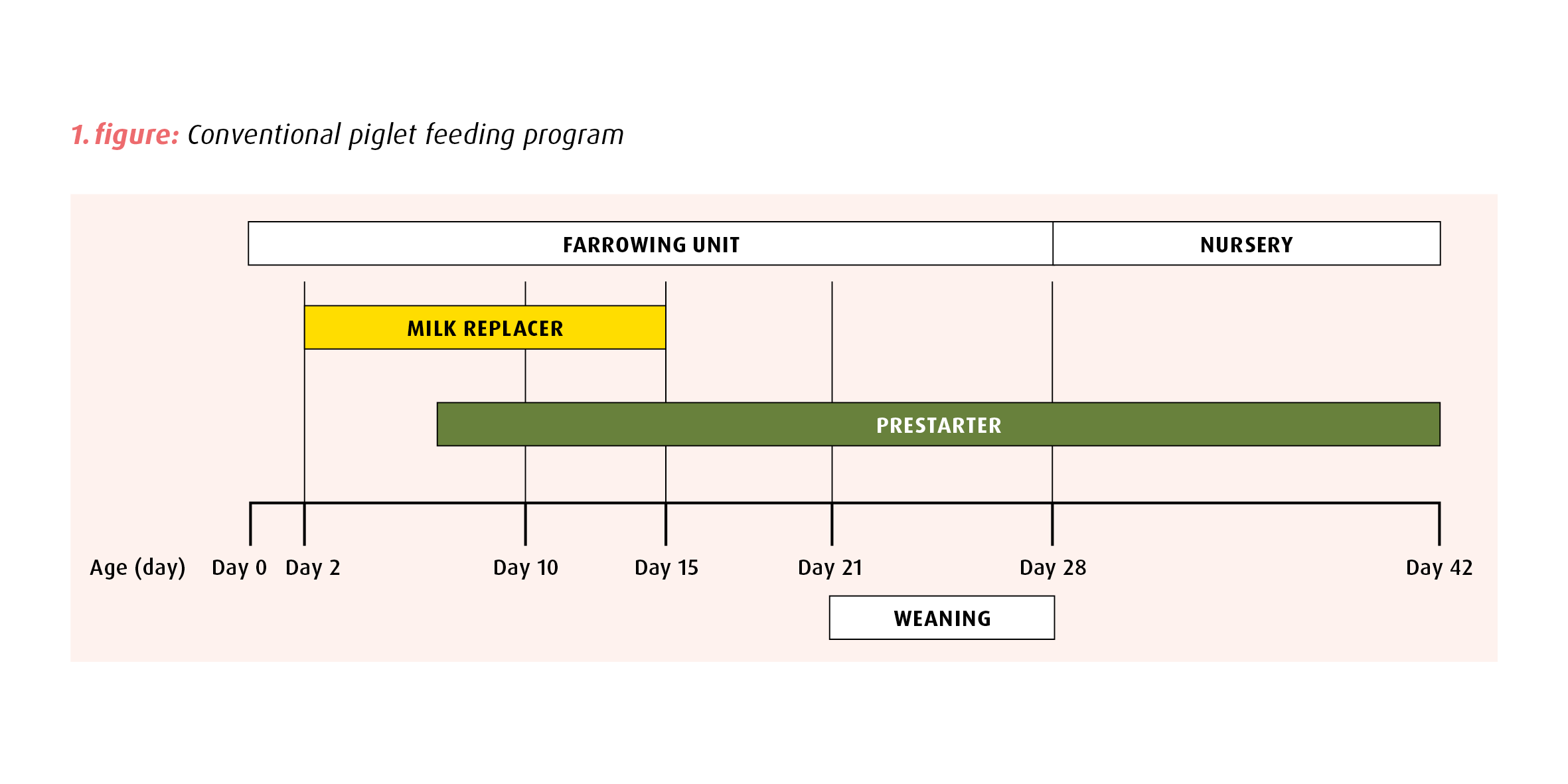 Automated systems, multi-phase feeding during the suckling phase
In modern pig production, automated liquid feeding systems are playing an increasingly important role by enabling early supplementary feeding of piglets during the suckling period. In multi-phase automated liquid feeding systems (Figure 2), piglets rely primarily on sow milk during the first days after birth, with a milk replacer introduced through the feeding system from 2 days of age. After the milk replacer and from 10–12 days of age, a liquid baby/prestarter feed can be introduced to support early supplementary nutrition. A solid prestarter feed is also introduced from the age of 15 days, providing a gradual transition between milk-based nutrition and the subsequent solid feeds. As in conventional feeding systems, weaning generally takes place between 21 and 28 days of age, depending on farm management practices. Prestarter feed is then provided throughout the early nursery phase, typically until 42 days of age. This gradual, multi-phase feeding strategy enables piglets to become used to supplementary feeds while still in the farrowing unit, ensuring the smoothest possible transition from milk-based to cereal-based nutrition. 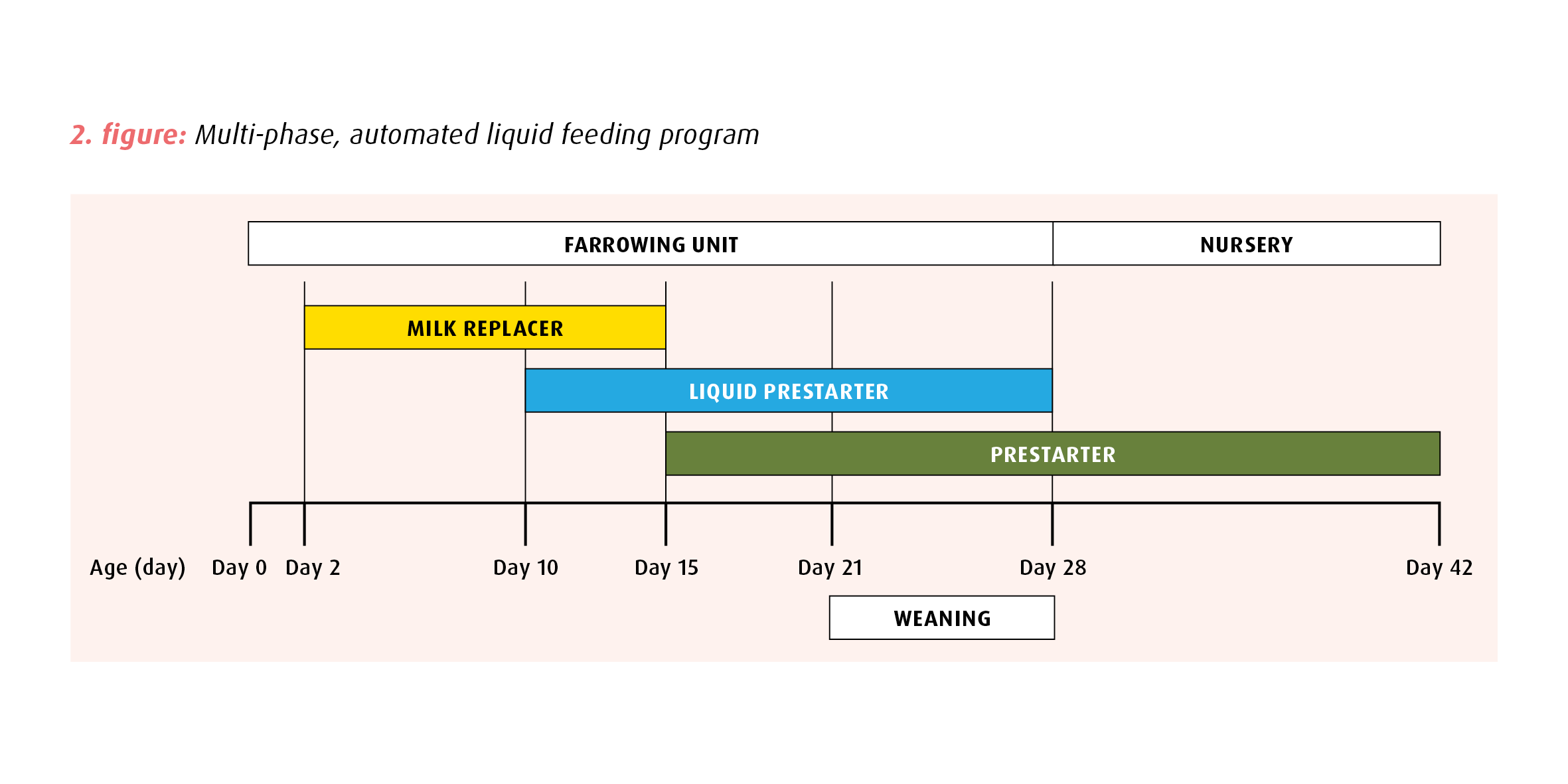 In addition, these liquid feeding systems equipped with automated milk kitchens provide substantial operational advantages on large commercial farms by providing partial automation of feed preparation, distribution and system cleaning. The combination of sensor-controlled feed dosing, precise feed distribution and high feed hygiene standards can contribute to more uniform piglet growth and more efficient rearing of litters.
To address these technological requirements, one of the primary objectives during the development of the Platino NEO Liquid prestarter feed was to ensure reliable performance under commercial conditions, since inadequate particle size distribution, sedimentation, poor solubility and the resulting inconsistencies in dosing are among the most common technological challenges associated with liquid piglet feeds. Consequently, particular emphasis was placed on optimizing both the physical characteristics and the manufacturing characteristics of the product. During product development, special attention was given to achieving a homogeneous distribution of the fine-particle components and ensuring consistent and high product quality under industrial-scale manufacturing conditions. The technological suitability of the formulation was subsequently evaluated on farm, under commercial conditions using several types of automated liquid feeding systems. The product demonstrated stable delivery, good solubility and a positive effect on piglet dry matter intake in all tested systems.
When used together with the Platino Milk Plusz kocatejpótló milk replacer, the Platino NEO Liquid prestarter is particularly well suited for application in automated liquid feeding systems equipped with milk kitchens, allowing its use already in the farrowing unit, while the Platino NEO-SB solid prestarter feed is suitable for conventional feeding systems.
The Platino NEO-SB prestarter, introduced to export markets in 2024, and the Platino NEO Liquid prestarter, scheduled for commercial launch in September 2025, have both been tested by our partners on commercial pig farms. The results obtained at one of the large-scale commercial production units included in the evaluation are summarized in Table 1.
Table 1: Production results in piglet feeding trials using Platino NEO Liquid and Platino NEO-SB prestarter feeds 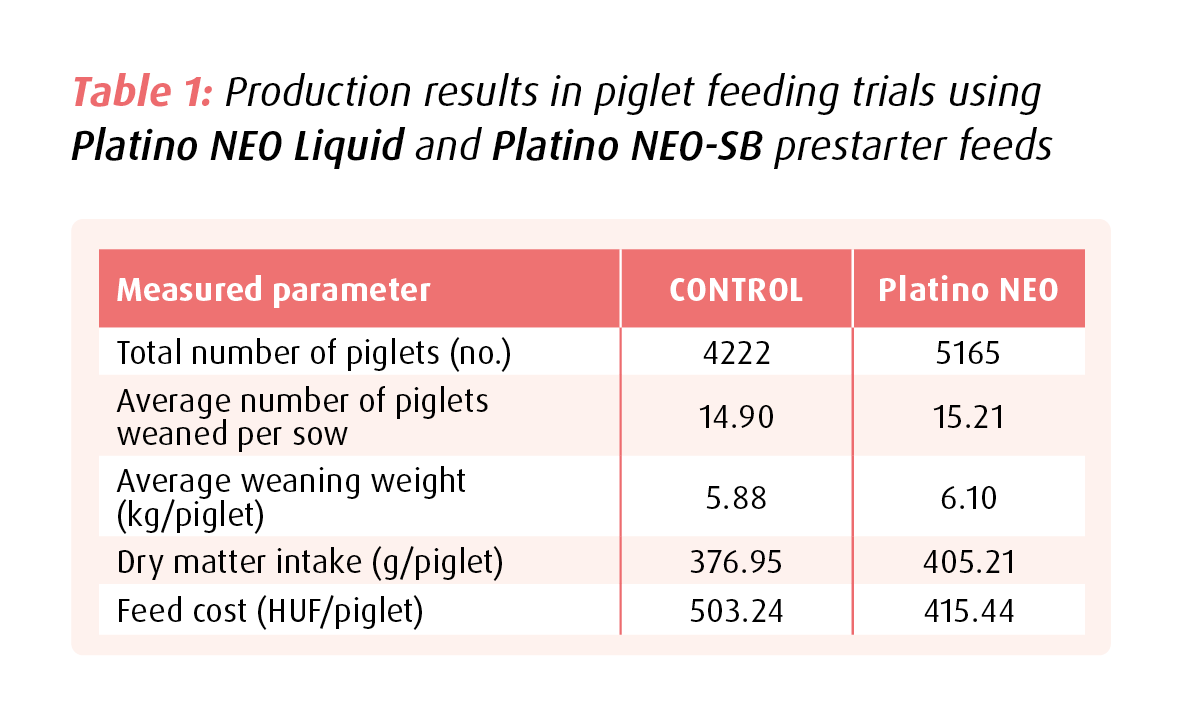 The results of the on-farm trials show that the average number of piglets weaned per sow increased from 14.90 to 15.21 when using Platino NEO Liquid and Platino NEO-SB prestarter feeds. The average weaning weight also increased by 0.22 kg per piglet. This result is important because weaning weight is considered to be an important starting point for further rearing results. By using the using Platino NEO concept, pre-weaning mortality was reduced by 13.99% compared to the controls, which suggests that this concept also improved the overall vitality of the piglets. Dry matter intake – another important parameter in the prestarter phase – was also higher in piglets fed with Platino NEO feeds: it increased from 376.95 g/piglet to 405.21 g/piglet. Feed cost decreased from 503.24 HUF/piglet to 415.44 HUF/piglet, resulting in a 17.40% decrease. Thus, we can conclude that improved production parameters resulted in lower feeding costs.
To evaluate the economic results of the piglet feeding trials using Platino NEO Liquid and Platino NEO-SB prestarter feeds, we took into account both the higher weaning weight and the lower feed cost per piglet in the treatment group compared to the controls. In the animals fed with the Platino NEO feeds average weaning weight was 0.22 kg higher than for the control group (6.10 kg vs. 5.88 kg). This means an increase of 192.93 HUF/piglet using a piglet price of 876.96 HUF/kg (calculated by using the German reference price (VEZG) and the EUR/HUF exchange rate on week 18 of 2026). In addition, feeding cost also decreased with the use of Platino NEO prestarter feeds by 87.80 HUF/piglet (HUF 503.24 vs. HUF 415.44) The increased revenue resulting from the higher weaning weights translates to HUF 6.8 million per year on a farm with 1000 sows and producing around 35,000 piglets per year. Calculating with the same herd size, over HUF 3 million can be saved in feed costs per year.
In summary, the use of liquid prestarter feeds provides a gradual transition from milk-based nutrition to cereal-based diets, thereby helping to reduce weaning stress and facilitating the adaptation of the digestive system to dietary change. Based on practical experience, the Platino NEO prestarter product range can be successfully integrated into the feeding programmes of modern pig production systems and offers an effective solution to the nutritional challenges associated with highly prolific sow genetics. Based on the above, the Platino NEO prestarter product range, as well as the in vitro crude protein digestibility evaluation system that supports its development, has the potential to make a meaningful contribution to improving both feeding efficiency and the competitiveness of the Hungarian pig industry by providing a broadly applicable solution to the nutritional challenges encountered on commercial pig farms.
Fédra Borbély
product manager
Bonafarm-Bábolna Takarmány Ltd.