

The qualitative and quantitative evaluation of protein and their building blocks, amino acids plays a key role in pig nutrition. This approach is indispensable for increasing feed efficiency. Previously feed proteins were evaluated based on their crude protein content. This approach, however, does not account for the digestibility of proteins and thus may lead to incorrect conclusions. The crude protein content of feed in itself will not show the amount of proteins that are digestible for the animal, and thus is not appropriate for determining the optimal and reasonable nutritional supply of the animal. We can understand feed quality and the actual availability of nutrients better by using the digestible crude protein content of feed, this approach allows us to improve feed efficiency while also decreasing environmental load.
In general, we can say that in swine the digestibility of proteins and amino acids is influenced by several factors. Among others the development and the health status of the animal’s gut, the quality and the chemical composition of the ingested proteins, the presence of antinutritive factors and the technological processes (e.g. thermomechanical treatment) applied during the production of feed. If too much protein leaves the small intestine undigested, it will be fermented in the hindgut, which together with the overgrowth of pathogenic bacteria will lead to diarrhoea. Post-weaning diarrhoea is one of the major contributors to loss of productivity worldwide, as it decreases the absorption of nutrients and increases bowel movements, further decreasing digestibility. Thus, it is very important to precisely know the digestibility parameters of dietary proteins in this production phase. It has to be noted that the digestion of proteins is further limited in young animals by insufficient enzyme production and gastrointestinal transit time (Tenke, 2023).
The “structure” or physical form of the feed also plays an important role in shaping the gastrointestinal environment, which has a direct effect on the digestibility of the specific nutrients. Particle size distribution of the different physical presentations of feed affects the secretory functions of the gut as well as the transit time of the chymus greatly. When comparing the different physical forms, we can say that a coarse mash will decrease gastric pH in pigs more than a fine mash or pelleted feed. Feeding a coarser feed will decrease the speed of digestion because of the higher dry matter content and the thickening of the gastric contents (Fig.1-2) The decrease in gastric pH is caused by the increased numbers of lactic acid bacteria and the increased concentrations of organic acids (Vukmirovic et al, 2017).
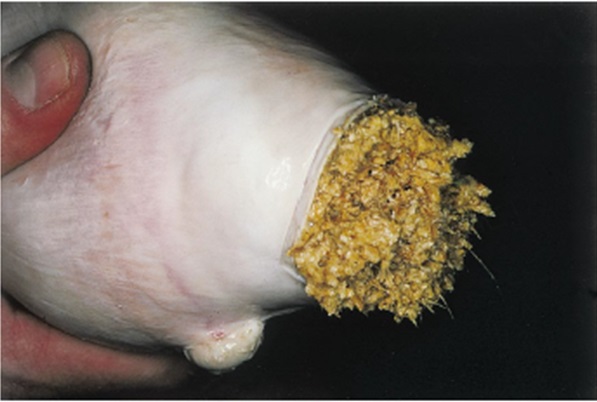
Source: Nielsen és Ingvartsen, 2000
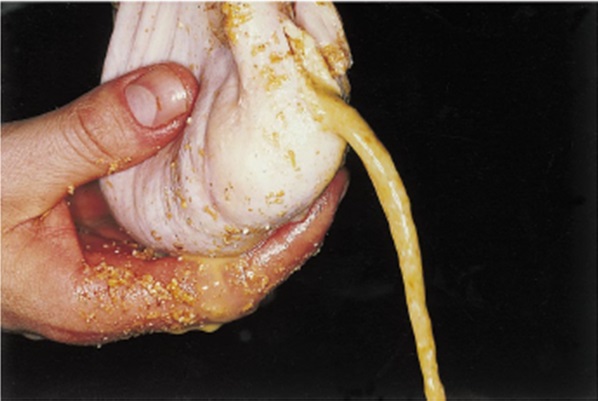
Source: Nielsen és Ingvartsen, 2000
Based on the interactions of the above-mentioned factors, it is quite clear that determining the digestibility of nutrients precisely is a complex task. This means we have to focus on selecting raw materials that are the best fit for our nutritional concept and have an optimal protein digestibility. Our experience shows that it is not enough to know the values stated by the manufacturer/distributor on the product sheet, since these digestibility values were not determined at standardised time points and don’t take species and age specific transit time into account. This is why we decided to perform in vitro digestibility studies in our own accredited laboratory to determine the digestibility of certain protein crops.
In the case of in vitro studies, it is of utmost importance to choose the appropriate methodology and to set incubation periods correctly. Specific physiological features also have to be considered, since the feed intake and the frequency of meals is different in weaned piglets compared to growers. Digestibility values found in literature are mainly determined for growers, but there are significant differences between the two age groups. This is why the pattern of feed intake specific for the piglets and the physical form of feed both have to be considered when interpreting and using study results. Our laboratory studies were aimed at collecting the digestibility test results for various potential protein sources in a database to obtain results that are based on the same experimental methodology. This database provides us a more precise approach for selecting raw materials, since it takes intestinal transit time into consideration beside the amount of undigested crude protein.
Table 1. shows the results of in vitro crude protein digestibility studies of various protein sources of plant and animal origin. The data include undigested crude protein content at 2 hours and the digestibility coefficient in percentages. The digestibility coefficient (%) shows the percentage of the crude protein content of a given protein source that is digestible and available for the animal.
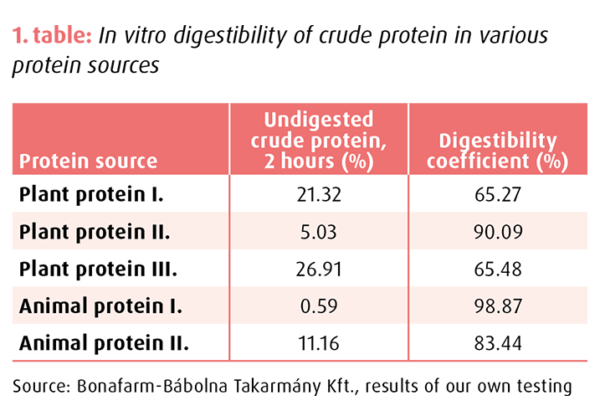
Beside protein sources of plant origin, animal protein can also be used in pig feed under strict conditions. Our results demonstrate that the indigestible proportion of crude protein in feed raw materials varies greatly, regardless of their origin (plant or animal), and this affects their nutritional value. Better protein digestibility is indicated by a higher digestibility coefficient. For example, the digestibility coefficient of animal protein I. is 98.87%, while it is only 65.48% for plant protein II., which indicates that a significant part of the crude protein content was not sufficiently digested. Undigested crude protein is not readily available for the animal and disrupts the balance of the gut microflora, leads to an overgrowth of pathogenic bacteria. The resulting dysbiosis increases the risk of diarrhoea, which then results in a loss of production efficiency.
The results of our in vitro trials were confirmed by trials in weaned pigs under commercial conditions. For the purpose of these trials, we optimise nutrition at the population level, not individually. This approach is the basis for our industrial research. These trials are based on two pillars: analysing production parameters (average daily feed intake, average daily weight gain, feed conversion rate, mortality and culling rate) and evaluating economic and ecological efficiency. These complex studies and analyses make it possible for us to optimise nutritional strategies, based on not only efficiency but also economic aspects.
In summary we can conclude that at Bonafarm-Bábolna Takarmány Kft. we are working on solutions that not only maximise the performance of the pigs but also take their well-being, as well as economic and environmental sustainability into consideration. Precise use of raw materials, the use of modern analytical equipment and the thorough knowledge of digestibility parameters of crude protein allow us to develop such feeding systems and approaches.
Literature:
Tenke, J. (2023): A takarmányok lizin/energia arányának hatása az aminosavak ileális emészthetőségére és a N-retencióra különböző genotípusú sertések hizlalása során. Doktori értekezés. Széchenyi István Egyetem. Mosonmagyaróvár
Vukmirović Đ.-Čolović R.-Rakita S.- Brlek T.-Đuragić O.- Solà-Oriol D. (2017): Importance of feed structure (particle size) and feed form (mash vs. pellets) in pig nutrition – A review. Animal Feed Science and Technology.Volume 233. 133-144. https://doi.org/10.1016/j.anifeedsci.2017.06.016
Nielsen E.K.-Ingvartsen K.L. (2000): Effect of cereal type, disintegration method and pelleting on stomach content, weight and ulcers and performance in growing pigs. Livestock Production Science.Volume 66, Issue 3. 271-282. ISSN 0301-6226.https://doi.org/10.1016/S0301-6226(00)00165-2
Fédra Borbély
product manager
Bonafarm-Bábolna Takarmány Kft.