


Metabolic studies with fistulated cows play an important part in the advancement of research related to the physiology and the nutrition of ruminants. This method allows us to examine and understand the elaborate and complex microbiological processes that take part in the rumen and gives us more precise information on the bypass features of specific raw materials (e.g. protein sources, amino acids, fat products).
The digestive physiology of ruminants is very complex and requires a precise knowledge of the proportion of rumen degradable and undegradable protein (RDP and UDP) and amino acids (e.g. methionine and lysine), structural (e.g. hemicellulose, cellulose) and non-structural (e.g. sugar and starch) carbohydrates, as well as the characteristics and the fatty acid composition of the lipid sources (e.g. full-fat soy, by-pass fat products) in the ration.
Of the above mentioned nutrients, we would like to highlight the importance of knowing the precise UDP (bypass protein) content of various protein sources, since UDP, along with the microbial protein produced in the rumen and their digestibility in the small intestine are of paramount importance in fulfilling the protein requirements in ruminants.
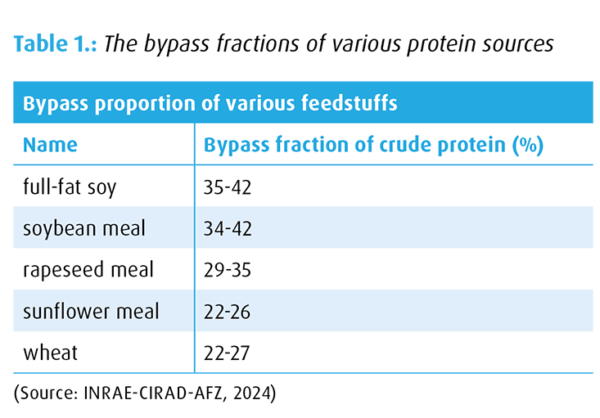
In Hungary the general practice is that about 70% of the protein provided in the ration is degraded in the rumen. However, high producing groups of dairy cows require a UDP ratio of 35-40% along with different carbohydrate fractions in the ration to be able to produce good quality milk at the high levels expected. The bypass fractions of the most commonly used protein sources are summarised in Table 1.
As a general rule, the protein sources included in the table are not enough to fulfil the bypass protein requirements of high-producing dairy cows, feedstuffs treated with various bypass protein technologies should also be added to their ration. The ruminal degradation of proteins can be reduced by using different methods: chemical, physical or combined processes. Although chemical and combined processes are effective, their high cost have led to a more widespread application of physical methods, in particular heat treatment. Today modern hydrothermal processes are used to limit the ruminal degradation of proteins. It is crucial to set the right temperature and processing time during heat treatment, since excessive heat will not only decrease ruminal degradation but also digestibility in the postruminal part of the gut (small intestine).
If we overestimate the UDP content of certain feedstuffs and consequently of the ration, it will lead to an increase in blood urea concentrations and reproductive problems in the herd. This underlines the importance of having relevant information regarding the UDP fraction of the bypass protein sources we use in feed.
Determining the rumen degradability of proteins with in vivo methods is an activity subject to animal testing authorisation and is regulated by Act XXXVIII of 1998 and Government Decree 40/2013 (II.14.) (URL1; URL 2). The study is performed under strictly regulated conditions with fistulated cows using an in sacco method.
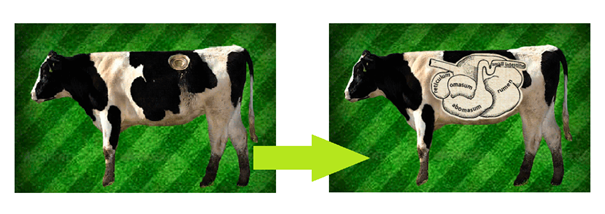
The in sacco method is the most widely accepted and used method for determining rumen degradability (Mehrez and Ørskov, 1977; Ørskov and McDonald, 1979). The method is based on putting measured amounts of various feedstuffs into 5 bags (5×10 cm) with standardised pore sizes and putting these bags into the rumen of cannulated Holstein-Friesan cows (Figure 1.) for a predetermined incubation time. Nutrient content is measured at the baseline and following the incubation period to determine the UDP fraction of the given feedstuffs.
These experiments can only be carried out under controlled conditions in collaboration with authorised research centres or universities because of the above mentioned legal and regulatory constraints. This year our full-fat soy based, protected protein and fat product, Soyzin turns 10 years old, a product for which we have already performed studies for determining the UDP fraction before putting it on the market. During the last two years we developed and added new products to our portfolio that were tested on fistulated cows (Rapeex, Linolex). The studies were performed at the Kaposvár Campus of the Hungarian University of Agriculture and Life Sciences. Rapeex is a rapeseed meal based, rumen protected protein source that provides a high UDP fraction due to its production process. This product is rich in methionine and as such can be an ideal complement to Soyzin that is rich in lysine to support an optimal amino acid supply.
Linolex is a linseed based protected protein and fat source rich in omega-3 fatty acids. It has a beneficial effect on reproductive functions and can reduce green house gas emissions associated with milk production. According to our studies, the UDP fraction in this product is more than 60% of the crude protein content. Our studies have shown that by using the manufacturing processes we developed, we could increase the UDP fraction in Rapeex to 60% and the UDP fraction in Linolex to 64%.
The results of our studies have shown that with properly adjusted and continuously monitored production parameters, the currently used manufacturing technology ensures that we offer our partners high quality and stable bypass protein products.
Fédra Borbély
product manager
Zoltán Hatvan
junior product manager
Bonafarm-Bábolna Takarmány Kft.