

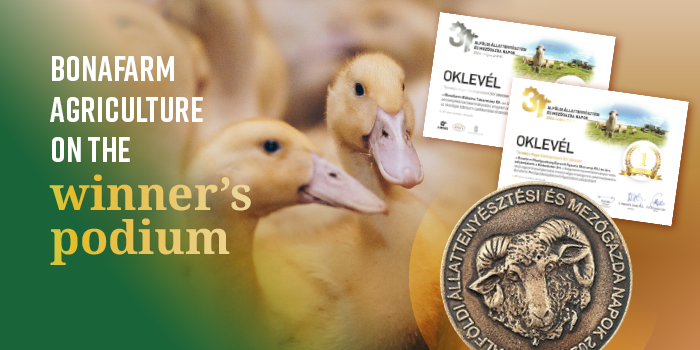
Bonafarm-Bábolna Takarmány Ltd. won 2nd place in the nutrition subcategory of the product award competition held in conjunction with the XXXI. Alföld Livestock and Agricultural Days International Trade Exhibition and Fair with its project “Alternative feeding program for broiler ducks to improve sustainability and reduce ecological footprint”.
The jury mentioned at the award ceremony that the entries that won the 1st and 2nd prize stood out in this subcategory, and there was only a slight difference between the two of them.
The Poultry division of Bonafarm Agriculture won 1st prize in the category of agroinformatics, management technologies and technology in cooperation with Birdwatcher Zrt. with their entry “Real time estimation of individual body weight in large scale poultry flocks by using artificial intelligence at the Poultry division of Bonafarm Mezőgazdaság”.
A total of 25 projects were nominated for the product award, 15 of them in the “Animal Husbandry Product Award” and 10 in the “Crop Product Award” category.
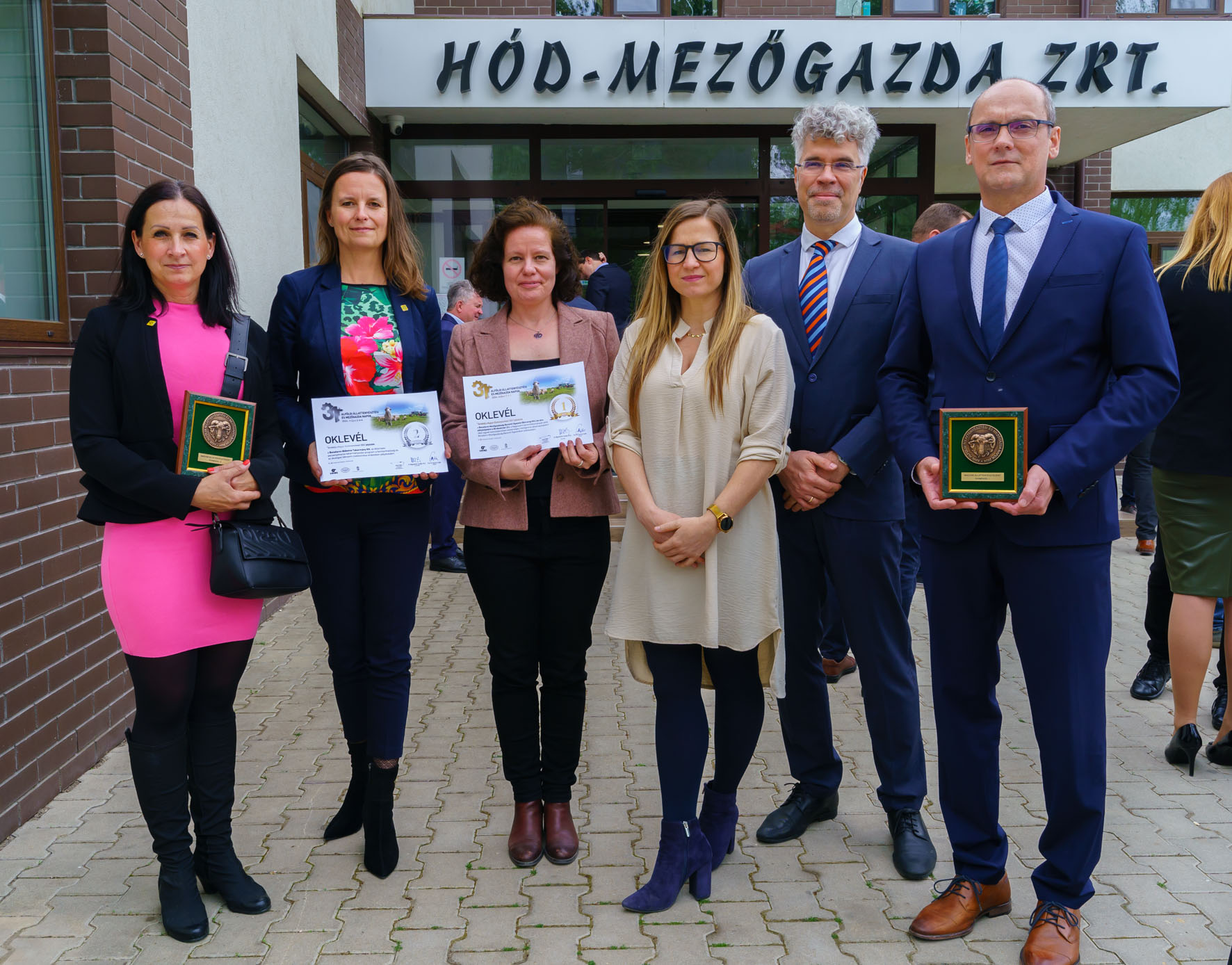
Krisztina Harmath Head of Marketing, Bonafarm-Bábolna Takarmány Ltd.
Dr. Márta Alexy Co-founder of the start-up Birdwatcher Zrt.
Beatrix Godó-Butty Precision engineer, Bonafarm Agriculture
dr. Sándor Szabó, Birdwatcher Zrt.
Lajos Lajtos Head of Poultry division, Bonafarm Agriculture
The alternative broiler duck feeding program of Bábolna Takarmány
During the course of our product development activities, we carried out experiments and developments in Hungary over the past year that were unique in their kind and were aimed at achieving economic sustainability in broiler duck production.
The reduction of nitrogen and phosphorous use to increase the ecological sustainability of broiler duck production as been the main topic of discussion for a long time because of tightening environmental regulations. However, in order to perform a complex evaluation of production efficacy, the carbon footprint also needs to be accounted for. This topic is of great interest because there is no data available regarding the carbon footprint of broiler duck rearing in Hungary.
In this regard, the aim of the broiler duck fattening trials carried out within the frame of our research and development activities was:
- To precisely formulate broiler duck feeds for the nutrients, to optimize the digestible amino acid content, to reduce nitrogen and ammonia emissions by precision feed manufacturing (using in-line NIR (Near Infrared) tools and our proprietary local PLS (Partial Least Squares) calibrations).
- To reduce the ratio of import protein sources such as soy bean meal by increasing the use of domestic protein sources, mainly industrial by-products to reduce carbon footprint.
- To minimise phosphorous emissions by reducing the use of MCP (monocalcium phosphate) and using phytase enzyme at a higher dose.
- To replace corn with sorghum, a crop that tolerates extreme weather conditions well, as an adaptation to climate change.
The following conclusions can be drawn from the results of the trials and experimental developments:
- The nitrogen uptake and thus the nitrogen excretion of the animals can be significantly reduced – while not compromising production results or cost optimisation.
- Soy bean meal – mainly of import origin – has a large carbon footprint but can be substituted with industrial by-products from Hungarian sources without affecting production results.
- By using phytase enzyme at a higher dose, MCP (monocalcium phosphate) can be excluded from certain feeding phases in broiler duck production, this means that the amount of added calcium and phosphorous can be reduced by 90% without any deterioration in the production or the health of the animals.
- By using our experimental feeds, carbon footprint could be reduced by 0.01-2.30 kg CO2 equivalent per broiler duck.
- Regarding the crude protein content of the finished feed, precision feed manufacturing (NIR technology) makes it possible to achieve a deviation as low as 3.1%, that is much tighter than required by law (12.5 relative %, as required by Annex 4 of Commission Regulation (EU) No 939/2010), which is of high importance both for meeting the nutritional needs of the animals and the reduction of emissions.
In summary, we are planning to implement a self-developed broiler duck feeding technology that is effective even under unfavourable economic conditions and at the same time meets ecological requirements and reduces the ecological footprint of broiler duck rearing.
How can we use artificial intelligence in poultry production?
Precision livestock farming technologies – regardless of the animal species and the management technology they are used in – represent an opportunity but also a challenge for large scale farms. Opportunity, in the sense that IT tools, methods and applications provide support for livestock farms in economic decision-making by providing insight to – often hidden – correlations between the factors influencing the production processes. This makes it possible to optimize the use of resources in animal production and to achieve an economically, ecologically and socially more traceable and competitive production. The development of the ChickCheck product by the Poultry division of Bonafarm Agriculture has shown that implementing new, innovative precision livestock farming technologies in practice can positively influence the profitability of the Poultry division of Bonafarm Mezőgazdaság from two aspects: one of them is the significant reduction in the workforce needed for manual weighing and the related wages – resulting in a lower cost of production in broiler rearing; the other is related to lower losses in planned slaughterhouse production that is a consequence of a more precise determination of the body weight of the slaughter animals and increases the amount of finished product produced. At the Poultry division of the Bonafarm Group real, authentic and traceable information is available regarding the performance of the poultry flocks.
A good precision solution is characterised by easy installation and ease of use, and provides reliable, authentic information. This requires a cooperation between the business developing the IT solution and the livestock farmer using it in practice.
There is growing interest for such IT applications that optimise production and processing or support the improvement of economic or ecological efficiency. This is especially true for production and integrator companies with a major market share such as the Poultry division of Bonafarm Agriculture, that are able to increase their competitiveness on both the domestic and the international market by utilising precision solutions that can be seamlessly integrated into the daily production protocol.
The practical implementation of precision technologies is almost always preceded by in-depth research: an increasing number of articles have been published in the past few years regarding the use of AI-models not only in broiler production but also for applications in layer and breeder flocks. Most of these publications use so called model experiments to evaluate and analyse the efficiency of artificial intelligence and machine learning – mainly deep learning algorithms in recognising the birds, or detecting behavioural or health problems. Results in these trials reveal great accuracy (96-97%), which is reduced to 60-65% once the technology is applied in a large scale setting (where they could convey added value to the producers).
The ChickCheck solution can be integrated into the production protocol of Bonafarm Agriculture and means an innovation in the integration that is novel not only in Hungary but also internationally.