
The performance of weaned piglets is greatly affected by the digestibility of the protein sources used in their diets. Part 1. of our series was dedicated to introducing the advanced in vitro protein digestibility method for evaluating the quality of certain protein crops (based on the digestibility coefficient) developed by Bonafarm-Bábolna Takarmány Ltd.; also providing the test results for these raw materials. This article will describe the use of these results in the development of pre-starter feeds.
There is an increased shift towards a differentiated approach in modern piglet nutrition that makes a distinction between “standard” and “protective” diets (Tybirk et al, 2024). The aim of standard diets is to optimise performance and feed conversion ratio in a healthy herd; while protective formulas provide solutions in the case of digestive challenges such as post-weaning diarrhoea, predisposition to enteritis or lower growth potential.
At Bonafarm-Bábolna Takarmány Ltd. we apply this differentiated approach in developing our pre-starter feeds, being among the first to offer reliable ZnO-free alternatives in piglet nutrition.
Developments did not stop there: our farm experiences and the availability of our in vitro digestibility results for various protein feedstuffs allowed us to ask the question: Is it possible to achieve results comparable to standard nutritional concepts by applying a protective approach in formulation and using our data base to pick protein crops with the best digestibility coefficients?
Bonafarm-Bábolna Takarmány Ltd. in cooperation with the swine division of Bonafarm Mezőgazdaság has performed pilot-scale model studies to determine how digestibility coefficients determined in laboratory studies are reflected in the performance and economic output of weaned piglets. The experimental feeds were formulated with the same nutritional content, differing only in the protein sources, by this we ensured that the in vitro digestibility values of the protein sources were the basis of formulation.
In the first model study we compared an experimental feed formulated based on the in vitro digestibility of the plant-based protein sources to a control feed with the same nutritional composition (energy, crude protein, digestible lysine). Our aim was to determine how the differences in digestibility determined in laboratory tests affect growth of weaned piglets in a commercial facility.
The in vitro crude protein digestibility of the protein source used in the control feed was 82.52%, while this component was changed in the experimental feed to one with an in vitro digestibility of 93.69%. This change had a significant effect on the formulation: the crude protein digestibility of the feed increased from 81.40% to 84.60%.
The first trial was performed with 300 male and female DanBred weaned piglets per treatment, in five replicates. Throughout the trial (between 25 to 46 days of age) microgranulated pre-starter feed and drinking water was provided ad libitum.
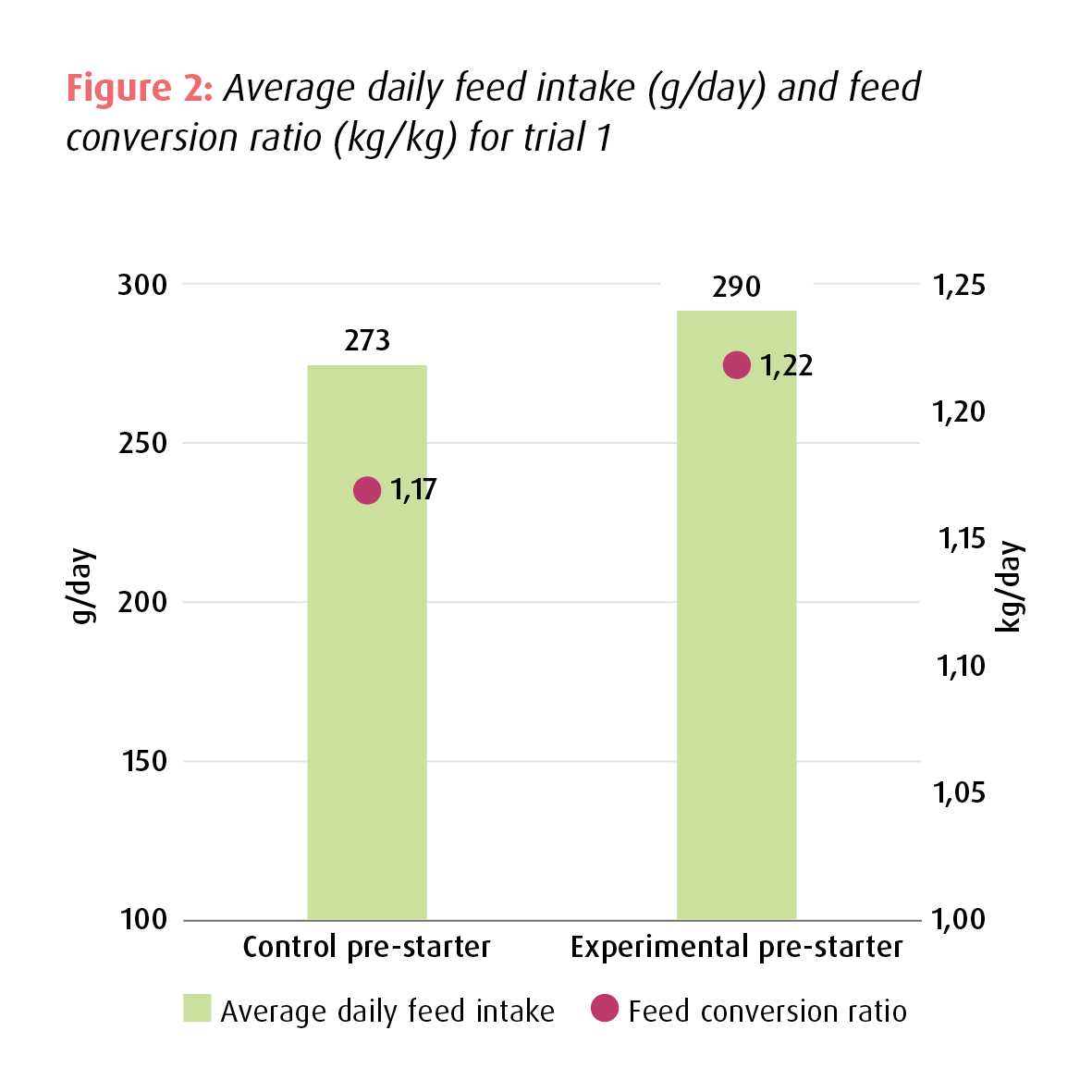
Figure 1. shows start and end body weights of piglets for the trial. There was no difference between the two groups regarding starting body weights. At the end of the trial, end body weight in the experimental group was 330 g higher than the control group (11.32 kg vs. 10.99 kg). Average daily weight gain in the experimental group was 240 g/day compared to 233 g/day in the control group. 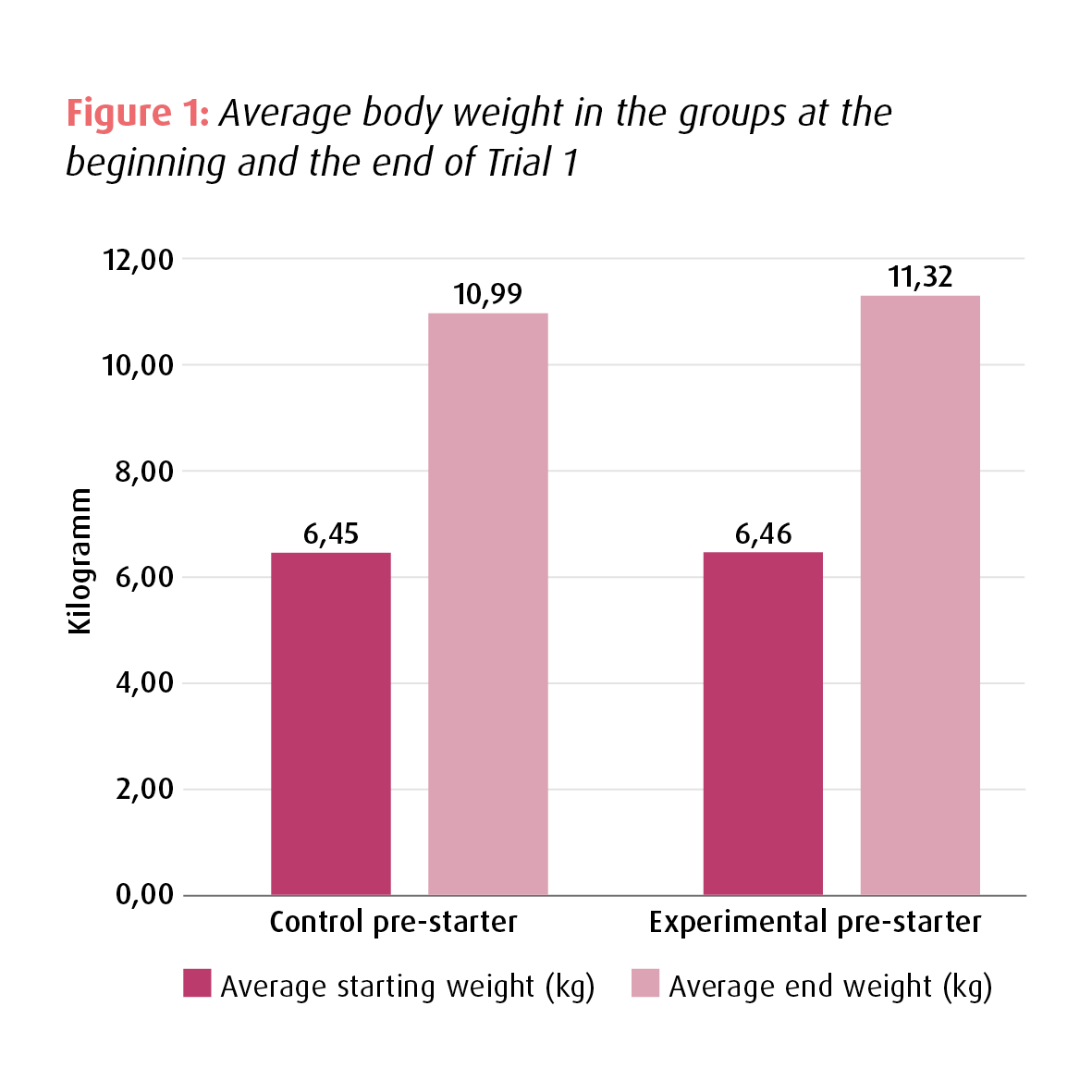 Average daily feed intake increased to 290 g/day with the experimental formulation, with 273 g/day for the control group. The following difference was observed for feed conversion ratio: FCR was 1.17 kg/kg for the control group and 1.22 kg/kg for the experimental group. The results are shown in Figure 2. Mortality rate was 1.25% in the control group and 0.42% in the experimental group.
  The economical evaluation of the results clearly supports the practical importance of changing the protein source. The piglets achieved 330 g higher body weights with the experimental feed by the end of the pre-starter feeding period. This was reflected in an improvement of the profitability indices. Even though the experimental feed cost almost 10% more per kg than the control feed, meaning that the the feed cost of 1 kg weight gain was HUF 36.7 higher, increased feed cost was compensated for by improved performance parameters.
Considering the current market price of fattening piglets, we can state that an additional average profit of HUF 460 per piglet could be realised. If these results are calculated for a 1000-sow farm with an annual output of 35,000 piglets, profit for the nursery phase of the production exceeds HUF 16 million, considering current piglet prices and HUF/EUR exchange rates.
The second trial was designed to evaluate and optimise the use of protein sources of animal origin. We replaced a protein source of animal origin with an in vitro crude protein digestibility of 85.07% to an alternative that had a digestibility coefficient of 98.98% according to our laboratory tests. This increased the digestibility of the crude protein content of the feed from 84.60% to 88.90%.
The trial included 1 352 DanBred piglets (n=676 piglet/treatment), in 5 replicates, both males and females. Body weight at the start of the trial was 5.80 kg for both groups. Microgranulated pre-starter feed was provided throughout the trial (between 23 to 44 days of age). The animals also had ad libitum access to drinking water.
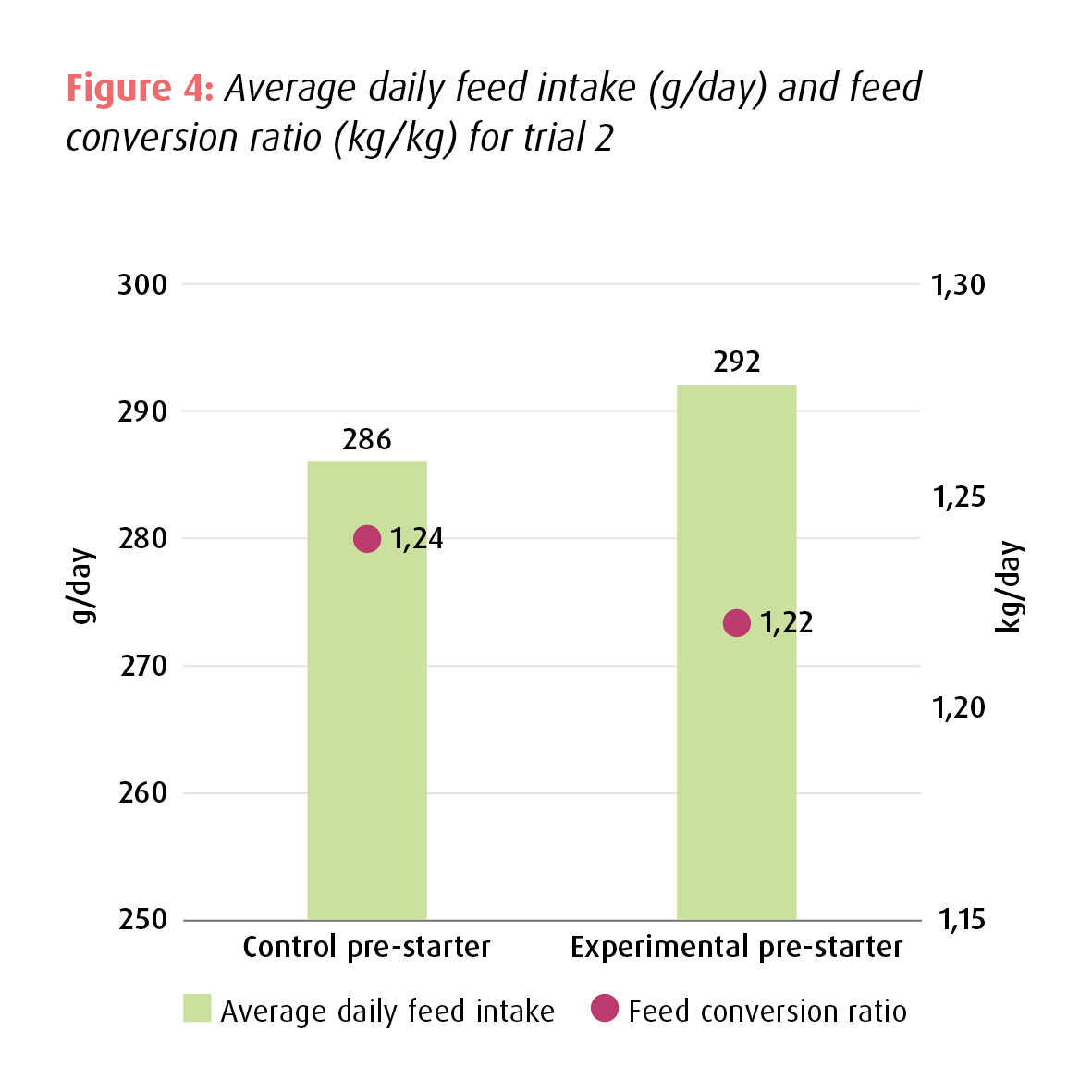
The piglets on the experimental pre-starter feed ended the trial with a body weight of 10.76 kg, compared with 10.59 kg for the control group. The results are shown in Figure 3. 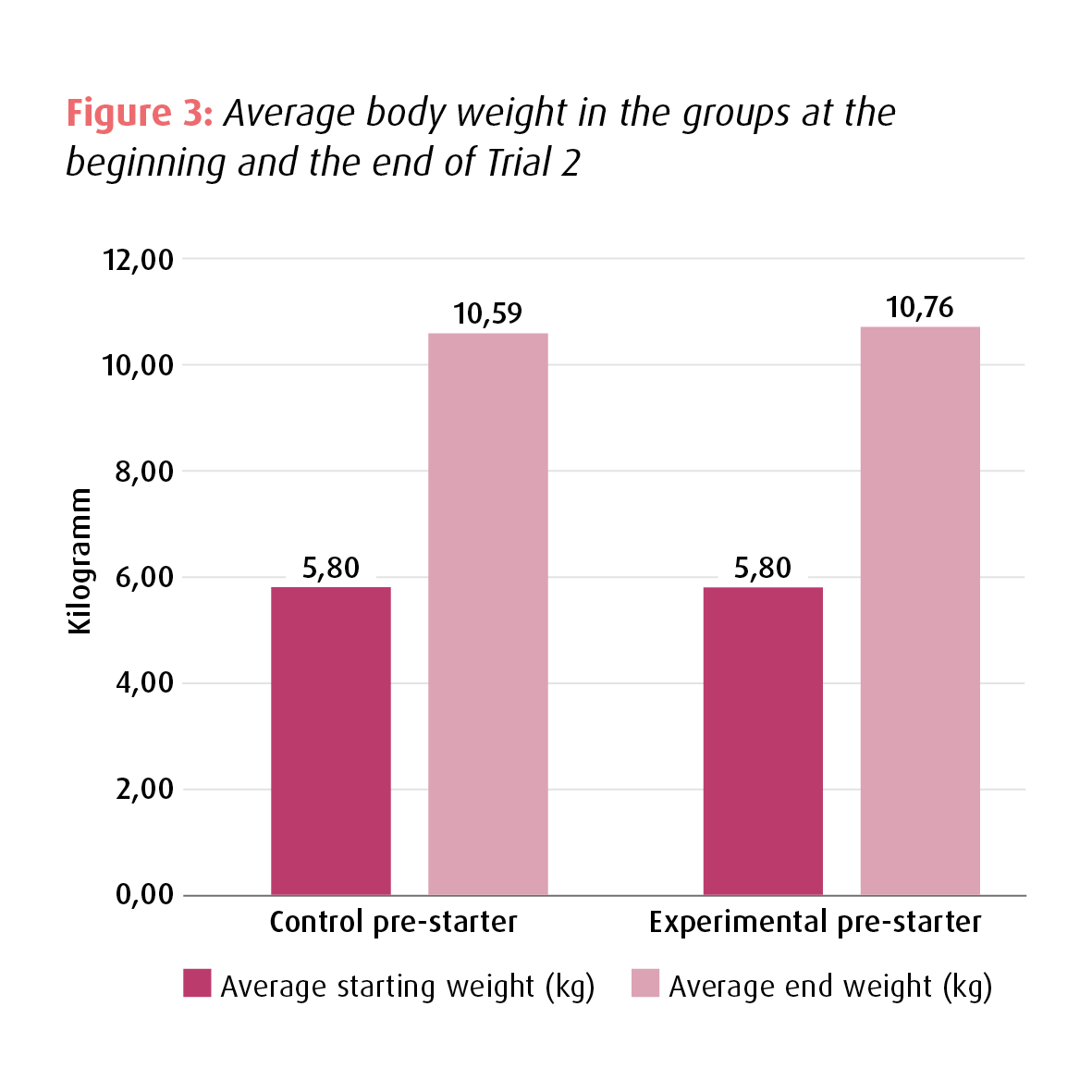 Beside an increase in average daily weight gain (control: 232 g; experimental feed: 239 g), daily feed intake increased also (control: 286 g; experimental feed: 292 g). Feed conversion ratio was 1.22 kg/kg in the experimental group, compared to 1.24 kg/kg in the control group. Feed intake and feed conversion ratio for the groups are summarised in Figure 4. Mortality rate was 1.12% in the control group and 1.31% in the experimental group. This represents a numerical difference between the two treatments, a statistically significant difference was not demonstrated. Culling rate was more favourable in the experimental group also (control: 2.61%, experimental: 1.68%).
  Economic analyses also confirm that replacing protein sources based on laboratory tests provides an advancement that can be appreciated from a practical point of view also. In the second trial, per kg cost of the experimental pre-starter feed was 1.8% higher than for the control feed. At the same time, because of the protein profile optimized for digestive physiology, the animals showed improved body weight gain compared to the control group: live weight increased by an average of 170 g per piglet by the end of the pre-starter phase. And even though the feed cost of 1 kg weight gain increased slightly (+1.8 HUF/kg), more efficient protein utilisation resulted in an additional profit of HUF 123.5 after accounting for the extra costs. This translates to an additional profit of HUF 4.3 million for a 1000-sow farm with an annual output of 35 000 weaned piglets. This result further supports the economic advantage of optimising feeds for crude protein digestibility, also in comparison with the previous trial.
The results of our two consecutive model experiments confirm that targeted selection of protein sources based on in vitro crude protein digestibility tests provides not only theoretical but also practical advantages, with improved performance demonstrated in piglets. Targeted use of protein sources with higher in vitro digestibility coefficients provides competitive growth performance and cost efficiency when formulating pre-starter diets with ingredients based on a “protective” approach compared to the “standard” diets.
Fédra Borbély
product manager
Bonafarm-Bábolna Takarmány Ltd.